The curse of children swearing
Children learn new words and expressions from a variety of sources. This can include swear words, which may surprise or concern parents. The C.S. Mott Children’s Hospital National Poll on Children’s Health asked a national sample of parents of children 6-17 years about their attitudes and experiences around children swearing.
In describing their own view of children using swear words, 47% of parents think it is never okay, 35% feel it depends on the situation, 12% think it depends on the word, and 6% say swear words are no big deal. Parents of teens (13-17 years) are more likely to say it depends on the situation, while parents of younger children (6-12 years) are more likely to say swearing is never okay.
Most parents say their child never (44%) or rarely (32%) swears; however, 24% say their child swears occasionally or frequently. Parents are more likely to report swearing at least occasionally for teens (37%) vs. younger children (14%).
Parents report different reasons for children swearing: out of habit (41%), to fit in with other kids (37%), to be funny (36%), or to get attention (21%), or because “it’s just the way kids talk these days” (27%). Parents attribute teen swearing to their teen trying to fit in, and swearing among younger children as their child trying to be funny or get attention.
Most parents (58%) feel that parents are responsible for their child’s swearing. When their child swears, parents describe their typical response is telling them to stop (41%), explaining why they don’t like it (38%), ignoring it (14%), or giving a punishment such as chores or grounding (6%). Parents of teens are more likely than parents of younger children to ignore swearing (21% vs. 8%).
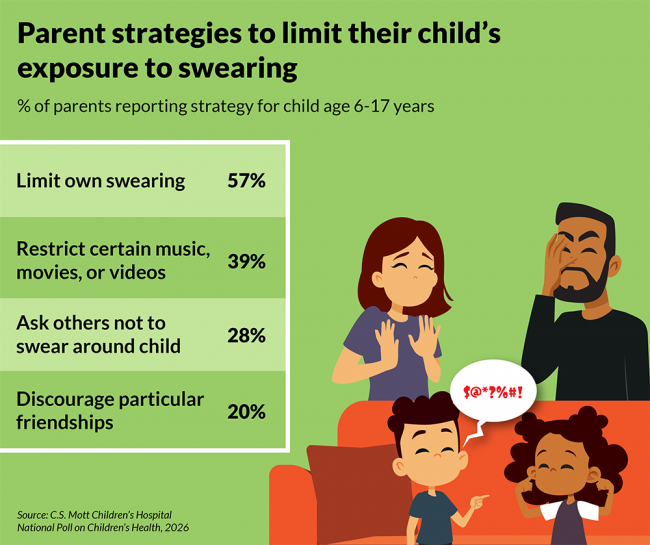
Parents say their child learns swear words from friends or classmates (65%) and popular media (58%); parents also point to themselves (45%) or other family members (44%) as the ones introducing swear words to their child. To limit exposure to swearing, parents watch their own swearing (57%), restrict certain media (39%), ask others not to swear around their child (28%), or discourage particular friendships (20%).
Highlights
- Only half of parents believe swearing is never okay for children.
- 1 in 4 parents say their child swears occasionally or frequently.
- 2 in 3 parents claim children learn swear words from friends or classmates.
- One-third of parents think their child swears to fit in with other kids.
Implications
This Mott Poll Report highlights an area of changing norms: a substantial number of parents acknowledge that their child swears, including nearly 4 in 10 parents of teens. Less than half of parents believe it is never okay for children to use swear words, while others consider the context. Some parents consider the range of swear words, with some being acceptable and others taboo. Moreover, one in sixteen parents think children swearing is no big deal.
Parents who object to children swearing likely have a range of reasons. Some parents may view swearing through a religious lens, believing it is against the tenets of their faith. Other parents may consider swearing to be a question of manners, as it could be viewed as impolite or disrespectful to swear in front of others. Parents also may consider swearing as a contextual issue, unacceptable at school or in public but less problematic when children are with their peers or at home.
There are numerous ways that children learn swear words, often from their friends and classmates, as well as popular culture such as TV, movies, or music. Family members are a common source of exposure to swearing, including parents themselves. Parents in this Mott Poll described strategies to limit their child’s exposure to swearing, most commonly to watch their own language and to ask people to respect their “house rules” about not swearing in front of children. Other strategies focused on external influences, such as parents restricting certain media or music. One in five parents said they discouraged their child from being friends with other children who swear; it seems likely that parents recognize other concerning attributes, beyond swearing, in these children.
It can be challenging for parents to maintain a consistent approach to swearing. Gone are the days of “washing your mouth out with soap”; instead, parents should sort through their own attitudes to determine which words and/or situations will merit a response. Young children may not realize certain words are inappropriate, so parents may need to explain meaning, context, and/or social impact of those words to build understanding and empathy.
Setting clear household expectations helps children know what is acceptable and what is not. Having a consistent and measured response to swearing is likely to be more effective than harsh punishment in guiding a child’s behavior. Parents should be prepared for children to argue that their friends have different rules; this provides an opportunity for parents to reinforce their own beliefs about swearing, while acknowledging that boundaries will be different for other families. Parents should expect pushback if their child catches them swearing – and be ready with an explanation that fits with their family rules.
Finally, parents may have different responses depending on their perception of why their child is swearing. For example, some children use strong language to express negative emotions, which may mean they need help naming and managing anger and frustration in more appropriate ways. Younger children may swear to get a reaction; a calm response can reduce the incentive to use these words.
link