Cook Children’s Neuroscientist Named Founding Director of Landmark Collaboration with UT Arlington
A pioneering collaboration between Cook Children’s Health Care System and The University of Texas at Arlington (UTA) is paving the way for research that will shape pediatric brain health and treatment now and for generations, while also building a novel partnership model linking clinical and academic communities to bridge the gap between scientific discovery and patient care.
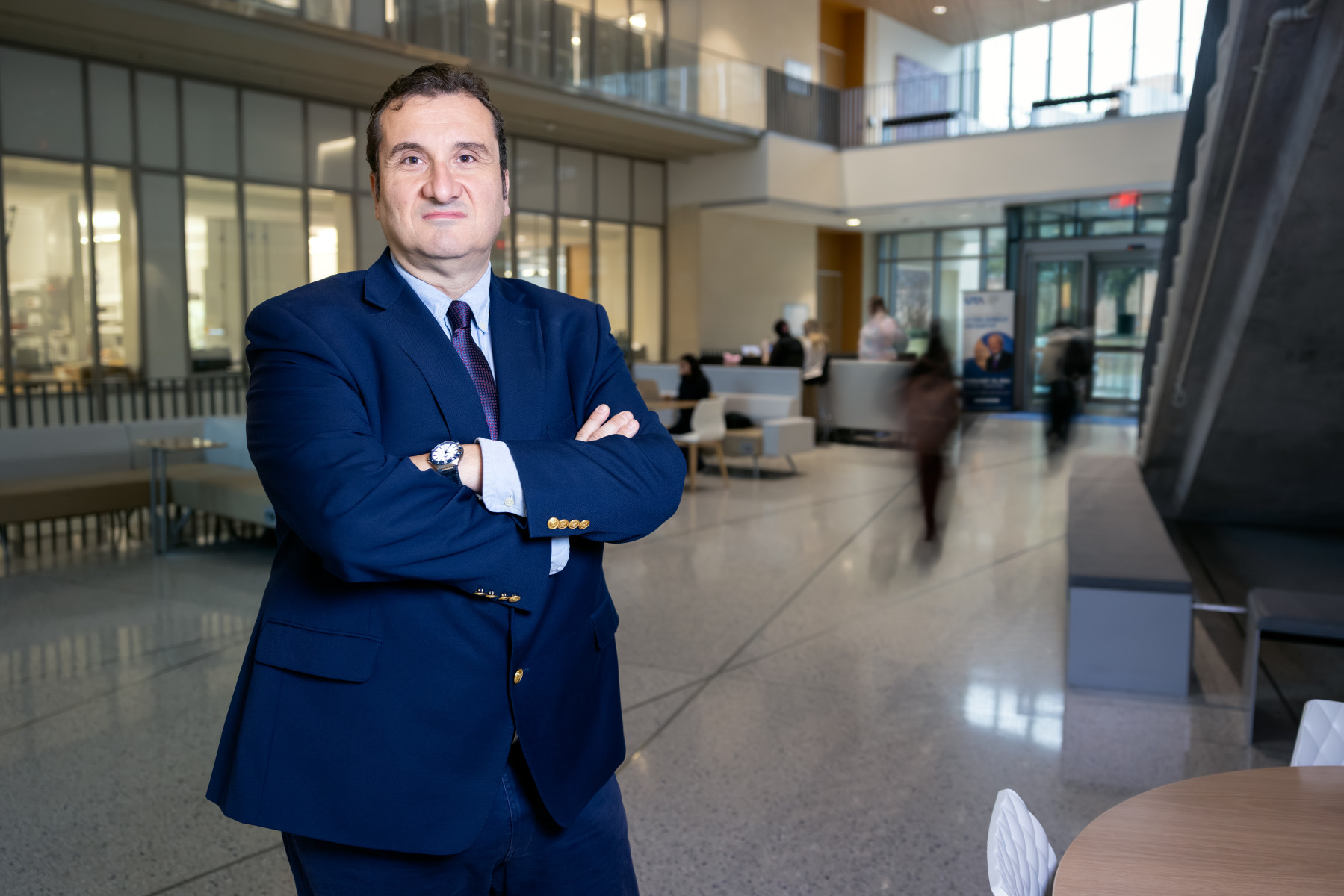
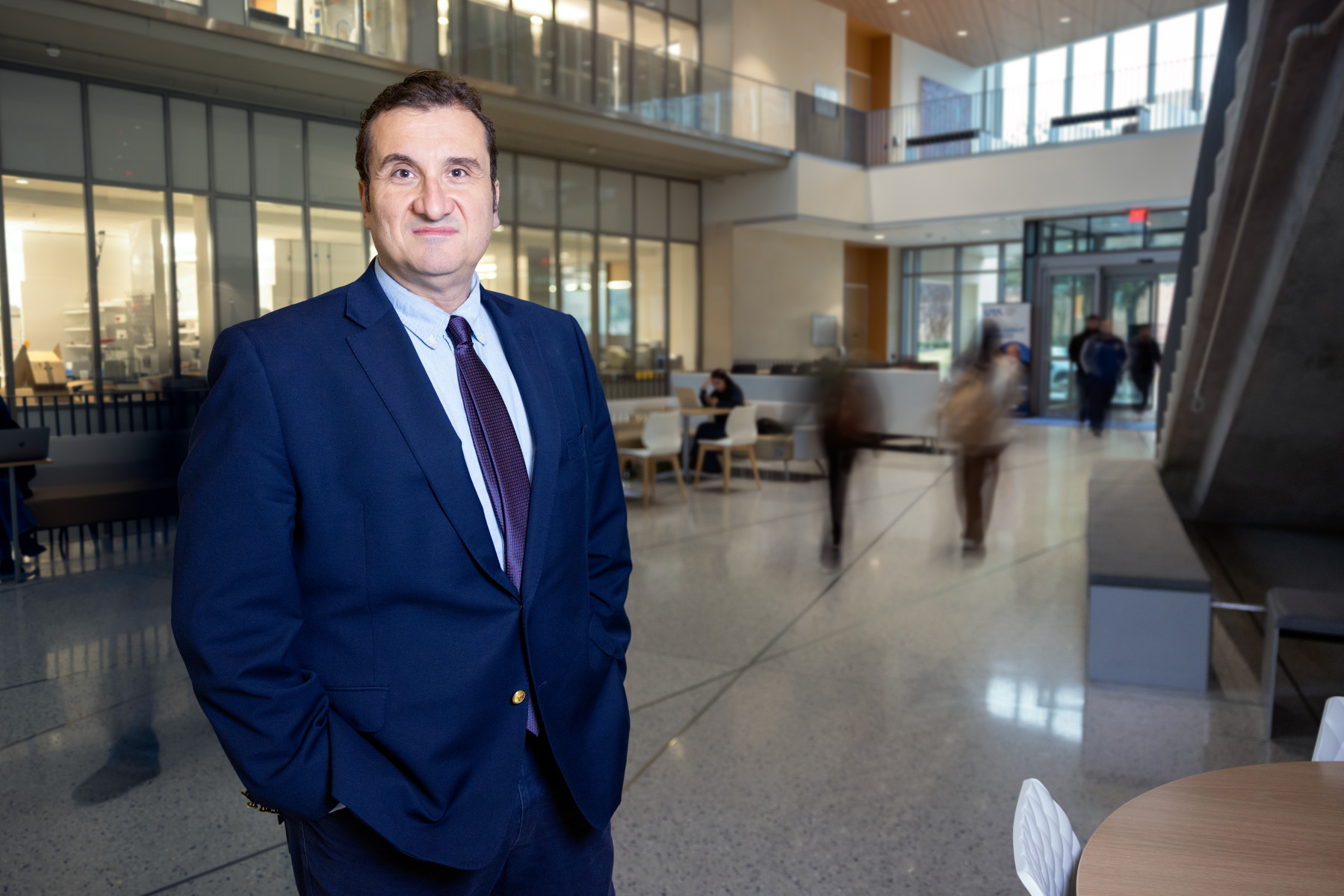 In the first formal joint staffing appointment between UTA and Cook Children’s, Christos Papadelis, Ph.D., assistant vice president of the Neuroscience Research Center at the Jane and John Justin Institute for Mind Health at Cook Children’s, has been named the founding director of the Cook Children’s and UTA Pediatric Brain Health and Neurosciences Center. Dr. Papadelis’ appointment establishes a path for Cook Children’s clinicians to join with UTA researchers to conduct patient-need-driven research for solutions to neurological, developmental, and movement disorders, as well as behavioral disorders associated with epilepsy.
While traditional research models often focus on long-term studies conducted at academic medical institutions, this collaboration aims to solve clinical problems with an immediate or near-term impact on patient care.
“This creative partnership gives us the ability for collaboration between Cook Children’s clinicians with real-world treatment problems and a UTA research teams so that, together, we can solve problems and make an immediate impact,” said Jon Weidanz, MPH, Ph.D., UTA’s senior associate vice president for research and founding director of the Institute of Biomanufacturing and Precision Medicine for North Texas. “That’s the beauty of this model.”
For Cook Children’s, the collaboration offers the best of both worlds. The health system can draw on the strengths of a top-tier research university to help power its imagination engine without compromising its culture as a patient-care-focused institution driven solely by its mission to do everything for the child. Cook Children’s also gains academic-level research credibility as a hub for translational research among the National Institutes of Health and philanthropic funders.
“Cook Children’s research program is larger than most realize,” said William Stigall, M.D. vice president and Chief Research Officer at Cook Children’s. “The goal of the research we do is to further our promise, “Everything for the Child.” Through research, we give our patients and families the opportunity to be a part of the latest and greatest in innovations that can directly
impact their lives. This collaboration with UTA will allow us to accelerate, deepen, and broaden all we’re doing for the children we care for.”
Bridging Innovation and Patient Care
Backed by over 20 years of translational research experience and with 100+ peer-reviewed research investigation articles under his belt, Dr. Papadelis brings a wealth of scientific expertise to this partnership, all driven by compassion for people.
“What I like to see with my research is how to help children,” Dr. Papadelis said. “That’s why I like what’s called translational research. It’s not science for the sake of science. It’s science for the sake of applying the knowledge to help somebody.”
Both organizations provide critical assets for translational research, which is the bridge connecting basic discoveries to the application of those discoveries within patient care.
“UTA has been active in translational research for a long time, but we want to expand in big ways,” Dr. Weidanz said. “I think Dr. Papadelis and this growing partnership with Cook Children’s is really setting all of that in motion. It’s really unique that we can bring the best of both worlds together so that we both excel in translational medicine. It’s a win for all of us, and most importantly, for patients.”
With its brain-trust of academic researchers, including doctoral and postdoctoral candidates, as well as leading-edge laboratories and technology, UTA provides the infrastructure for imagination-driven discovery that could lead to breakthroughs in treating rare and complex neurologic conditions in children.
Cook Children’s diverse patient population offers UTA researchers an expanded pool of potential study participants. In addition, the health system’s vast network of clinical experts, who understand the unique needs and challenges of pediatric health care, can apply and evaluate research findings in real time within their care settings.
“Our department is a support system for this work,” said Luke Hamilton, Cook Children’s director of Clinical and Translational Research. “Our scientists have expertise in translating data produced from clinical encounters, aggregating, and analyzing for findings to create a new evidence base that can be fed back to our clinicians and improve clinical care.”
A Ripple Effect
Along with enhancing Cook Children’s ability to deliver evidence-based innovation in patient care, this collaboration boosts both organizations’ ability to attract competitive federal funding, postdoctoral talent and joint appointments, which increases their visibility in academic publishing and conference networks.
The local economy could score big, too.
“We shouldn’t overlook economic development and the impact we can have on growing our community,” Dr. Weidanz said. “I think these collaborations, starting with Dr. Papadelis and looking forward to what comes next, could eventually lead to the commercialization of some of these new findings, and that translates to jobs. Of course, we’ll never lose sight of the patient, but these partnerships really help the community flourish.”
From Ancient Cities to the Western Frontier
Born in Athens, Greece, and raised in Thessaloniki, Dr. Papadelis parlayed an electrical engineering diploma from Aristotle University into a career studying the electrical pathways of the pediatric brain, taking special interest in epilepsy and movement disorders such as cerebral palsy.
“I found that engineers like objects, but they don’t like communicating with people,” Dr. Papadelis said. “I’m a very extravagant personality. I like to connect with people, and I talk a lot, so I realized I didn’t belong there. But the engineering school gave me knowledge of how to use engineering skills in health care to help physicians. That’s when I went for a master’s and Ph.D. in biomedical engineering. I found my spot there and realized there is so much technology and tools that we can use to help physicians, and this is what I found fascinating.”
In his prestigious career, Dr. Papadelis has lived and worked in five cities throughout four different countries across three continents. At the RIKEN Brain Science Institute in Japan, he honed his skills in the neuroimaging technique known as magnetoencephalography (MEG)—the fastest brain imaging tool available, allowing doctors to see brain activity in real time. In Trento, Italy, Dr. Papadelis marveled at his daily view of the Italian Alps while completing a post-doctoral fellowship at the Center for Mind/Brain Sciences at the University of Trento.
In 2011, the neuroscientist made his way across the pond for his first faculty appointment—a professorship teaching neurology at Harvard Medical School. He also joined the research staff of Boston Children’s Hospital, where he led the development of its clinical MEG laboratories and programs.
Cook Children’s invited Dr. Papadelis to join the health system in 2019. His heart for connection made him the perfect fit for a health system whose promise to do everything for the child is fueled by kindness, collaboration and imagination. The prospect of warmer weather made the offer all the more attractive.
“I was looking for a change in my career, and I decided to give it a try,” Dr. Papadelis said. “I moved down here with my family, and we love it. We felt really welcome. Being Greek, I feel like I belong in the south because I like the weather.”
Dr. Papadelis was first named Cook Children’s founding director of Research within its Neurosciences program. In September 2024, he became the assistant vice president of Research at the newly opened Jane and John Justin Institute for Mind Health at Cook Children’s. The Cook Children’s team he leads includes several UTA faculty members, postdoctoral researchers, alumna and research assistants, as well as a host of UTA doctoral students.
Since arriving in North Texas, Dr. Papadelis has led Cook Children’s to new heights with several “firsts” for the health system. These include Cook Children’s receiving its first research grant from the National Institutes of Health, securing its first patent, and achieving its first fully approved Institutional Review Board (IRB) protocol for using Transcranial Magnetic Stimulation in conditions like cerebral palsy.
While his research covers a broad range of studies in neuroscience, clinical neurophysiology and biomedical engineering, Dr. Papadelis’ main goal is to develop a novel epilepsy biomarker that will help children with drug-resistant epilepsy become seizure-free after resective neurosurgery, and he’s well on his way. Under his leadership, Cook Children’s Neurosciences research team has uncovered several new signs for identifying the epileptogenic zone with high precision, and developed new AI tools for predicting surgical outcomes in children with drug-resistant epilepsy. These discoveries and prediction tools help guide physicians in their treatment, improve the accuracy of surgical interventions, and give new hope to patients with uncontrolled seizures.
“Cook Children’s is not just a hospital that takes care of the children in the region,” Dr. Papadelis said. “We develop here, and we perform very innovative research that has been recognized nationally and internationally by the scientific community.”
Shortly after joining Cook Children’s, Dr. Papadelis also joined UTA’s faculty as a professor of Bioengineering. From that relationship grew the framework for the Pediatric Brain Health and Neurosciences Center partnership. In addition to his Cook Children’s team, Dr. Papadelis oversees a 16-member research team at UTA, while also mentoring several doctoral and postdoctoral candidates.
“Dr. Papadelis is an incredibly passionate, creative and curious scientist with an eye on delivering his research findings to the patient,” Dr. Weidanz said. “He laid the groundwork for what’s to come, and that is a very strong partnership between UTA and Cook Children’s.”
link